The Rich History of Abstract Art Movement: A Deep Dive
history of abstract art movement

The Rich History of Abstract Art Movement: A Deep Dive

Unravel the revolutionary journey of abstract art, its pioneers, and its profound influence on visual culture.

Begin Your Journey

Key Takeaways

  • ✓ Abstract art began in the early 20th century as a radical departure from traditional representational art.
  • ✓ Pioneers like Wassily Kandinsky, Kazimir Malevich, and Piet Mondrian were instrumental in its development.
  • ✓ It encompasses a wide range of styles, from geometric abstraction to lyrical abstraction.
  • ✓ The movement challenged the very definition of art, focusing on form, color, and emotion over literal depiction.

How It Works

1
Understand the Precursors

Before diving into abstraction, grasp the societal and artistic shifts of the late 19th century that set the stage. Impressionism and Post-Impressionism, for instance, began to loosen the ties to strict realism.

2
Identify Key Pioneers

Focus on the foundational artists who first broke away from objective representation. Their manifestos and early works provide crucial insight into the initial philosophical underpinnings of the movement.

3
Explore Diverse Styles

Recognize that abstract art is not monolithic. Delve into different branches like Cubism, Suprematism, De Stijl, Abstract Expressionism, and more to appreciate its breadth and evolution.

4
Analyze Cultural Impact

Consider how abstract art influenced not only painting and sculpture but also architecture, design, and even philosophy. Its impact resonates through various aspects of modern and contemporary culture.

The Revolutionary Dawn of Non-Representational Art

Dynamic abstract art with vivid colors and bold brushstrokes. Photo: Steve A Johnson / Pexels
The early 20th century was a period of immense societal upheaval and rapid technological advancement, a fertile ground for radical artistic experimentation. The history of abstract art movement is inextricably linked to this era, emerging as a profound rejection of traditional academic art, which prioritized realistic depiction and narrative storytelling. Artists felt that photography had rendered literal representation less vital, freeing them to explore the inner world, emotions, and the inherent properties of form and color. This was not a sudden break but a gradual evolution, building upon the foundations laid by movements like Impressionism and Post-Impressionism, which had already begun to challenge the strictures of realism by emphasizing subjective experience and the artist's perception over objective reality. Artists such as Paul Cézanne, with his geometric simplification of forms, and Vincent van Gogh, with his expressive use of color and brushwork, paved the way for a more subjective and less literal approach to art. Symbolism, another influential precursor, delved into the realm of dreams, myths, and the subconscious, moving away from the tangible world and towards an exploration of inner states. These movements collectively created an environment where the idea of art existing purely for its aesthetic and emotional qualities, rather than its descriptive function, could take root. The true genesis of abstract art is often attributed to Wassily Kandinsky, a Russian artist who published 'Concerning the Spiritual in Art' in 1911. In this seminal text, Kandinsky articulated his belief that art should express the artist's inner spiritual life, free from the constraints of the material world. He argued that colors and forms possessed intrinsic spiritual vibrations, capable of eliciting profound emotional responses. His early abstract works, often referred to as 'Improvisations' and 'Compositions,' are characterized by vibrant, clashing colors and dynamic, non-objective forms, aiming to evoke a musical experience through visual means. Kandinsky's theories and paintings marked a definitive break, positing that art could be purely abstract, existing independently of any recognizable object or scene. Simultaneously, other artists across Europe were exploring similar territories, albeit with different theoretical frameworks. In Russia, Kazimir Malevich developed Suprematism, a movement focused on fundamental geometric forms and pure color, believing that art should be free from any social or political meaning. His iconic 'Black Square' (1915) became a profound symbol of this radical reduction, representing the 'zero point of painting' – the ultimate liberation from objective representation. Meanwhile, in the Netherlands, Piet Mondrian, inspired by Cubism, pursued a geometric abstraction he called De Stijl, reducing his palette to primary colors and non-colors (black, white, grey) and his forms to horizontal and vertical lines, aiming for universal harmony and spiritual order through pure geometric relationships. These pioneering efforts, though diverse in their approaches, shared a common thread: a desire to create an art that transcended the visible world and spoke directly to the human spirit through its intrinsic visual elements. This period laid the groundwork for the incredibly diverse and influential history of abstract art movement that would unfold throughout the 20th century. For more on how these early ideas shaped artistic expression, explore the broader context of modern art movements.

Cubism, Futurism, and the Fragmentation of Reality
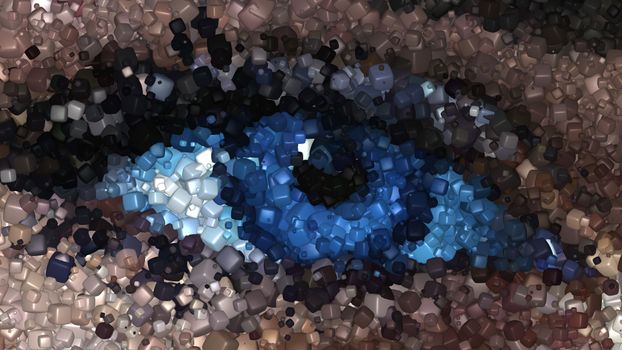
Creative mosaic artwork depicting a stylized eye with vibrant blue tones, ideal for modern design and visual art projects. Photo: 3D Render / Pexels
While not purely abstract in its initial phase, Cubism, developed by Pablo Picasso and Georges Braque around 1907, played a pivotal role in the history of abstract art movement by radically reconfiguring the way artists perceived and depicted reality. Cubism shattered traditional perspective, representing objects from multiple viewpoints simultaneously, dissecting them into geometric facets, and reassembling them on the canvas. This intellectual approach to representation, moving away from a single, fixed viewpoint, forced viewers to engage with the artwork on a conceptual level, rather than merely recognizing a scene. Early Analytical Cubism, with its muted palette and complex, overlapping planes, often made subjects difficult to discern, pushing the boundaries of representation closer to abstraction. Later, Synthetic Cubism introduced collage elements and bolder, simpler forms, further emphasizing the flat surface of the canvas and the construction of the image rather than its illusionistic qualities. The Cubist revolution in perception profoundly influenced subsequent abstract artists, demonstrating that visual reality could be manipulated and reinterpreted, opening the door for complete non-objectivity. Following closely on the heels of Cubism, Futurism, an Italian art movement founded by Filippo Tommaso Marinetti in 1909, embraced speed, technology, and the dynamism of modern life. Futurist artists like Umberto Boccioni, Giacomo Balla, and Carlo Carrà sought to capture motion and energy in their paintings, often depicting subjects in blurred, fragmented forms that conveyed a sense of simultaneous movement. While still rooted in depicting identifiable subjects (trains, cars, dancers), their emphasis on dynamism, interpenetrating forms, and the breaking down of solid objects into lines of force and color pushed them towards abstraction. They were interested in the 'universal dynamism' – the invisible forces that animate the world. This focus on energy and movement, rather than static representation, contributed significantly to the abstract vocabulary, influencing artists who sought to express intangible concepts through purely visual means. Both Cubism and Futurism, by dismantling traditional methods of representation and exploring new ways to convey perception and experience, acted as crucial bridges from representational art to the fully non-objective forms that would define later abstract movements. They taught artists and viewers alike to see beyond the literal, to appreciate the power of form, line, and color as expressive agents in their own right, paving the way for the radical shifts that would continue to define the trajectory of abstract art.

Post-War Abstraction: Expression, Color, and Action
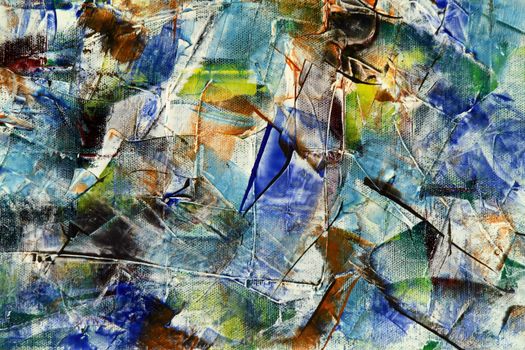
Dynamic abstract expressionist painting with vibrant colors and textured patterns. Photo: Steve A Johnson / Pexels
The aftermath of World War II ushered in a new era of abstract art, particularly in the United States, where Abstract Expressionism emerged as the dominant avant-garde movement. This was a direct response to the horrors of war and the existential anxieties of the mid-20th century, where artists sought a visual language capable of expressing profound personal and universal emotions, unbound by traditional forms or narratives. New York City became the epicenter of this movement, marking a significant shift in the global art world from Paris to America. Abstract Expressionism encompassed two main tendencies: 'action painting,' characterized by energetic, gestural brushwork and spontaneous application of paint, exemplified by artists like Jackson Pollock and Willem de Kooning; and 'color field painting,' which focused on large, flat areas of color to evoke a meditative or sublime experience, championed by artists such as Mark Rothko and Barnett Newman. Jackson Pollock's revolutionary 'drip paintings,' where he poured, dripped, and splattered paint onto canvases laid on the floor, were a radical departure from conventional painting techniques. His method emphasized the process of creation itself, turning the canvas into an arena for action and expressing raw emotion directly through the physical act of painting. This approach, often seen as a direct extension of the artist's psyche onto the canvas, was deeply influential, signaling a new freedom in artistic expression. Willem de Kooning, while retaining a more traditional brushstroke, imbued his works with a powerful, almost violent energy, often blurring the lines between figuration and abstraction in his 'Woman' series. His intense, aggressive brushwork and vibrant palette conveyed a sense of struggle and vitality. In contrast, Color Field painters like Mark Rothko sought to create immersive, contemplative experiences through vast expanses of color. His large canvases with soft-edged, luminous rectangles of color aimed to evoke deep emotional and spiritual responses, inviting viewers into a transcendent space. Barnett Newman's 'zip' paintings, characterized by a single vertical line dissecting a large color field, sought to achieve a similar sublime effect through extreme simplification and monumental scale. These post-war abstract movements profoundly impacted the history of abstract art movement by emphasizing individual expression, the materiality of paint, and the emotional power of color and form, pushing the boundaries of what art could be and how it could communicate. They moved away from the geometric precision of early abstraction towards a more fluid, intuitive, and deeply personal engagement with the canvas, further solidifying the role of non-representational art as a powerful force in contemporary culture. Understanding these diverse approaches is key to appreciating the full scope of artistic expression in the 20th century.

Tips for Appreciating and Understanding Abstract Art
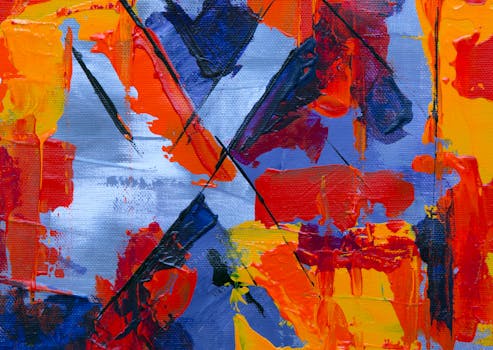
Expressive abstract painting with vibrant colors and dynamic patterns on canvas. Photo: Steve A Johnson / Pexels
Understanding and appreciating abstract art can sometimes feel daunting, especially for those accustomed to representational forms. However, approaching it with an open mind and a few key strategies can unlock a world of rich visual and emotional experiences. The most crucial tip is to let go of the need to 'understand' abstract art in the same way you would a narrative painting. Instead of asking 'What is it?', try asking 'How does it make me feel?' or 'What is the artist trying to communicate through these colors, forms, and textures?'. Abstract art often aims to evoke an emotional response, stimulate thought, or explore pure aesthetic qualities rather than depict a recognizable object or scene. Focus on the formal elements: the lines, shapes, colors, textures, and composition. How do they interact? Do they create harmony or dissonance? Is there a sense of movement or stillness? The artist's choices in these elements are deliberate and convey meaning. Another helpful approach is to consider the context in which the art was created. Knowing a little about the artist's background, their philosophical leanings, or the historical period can provide valuable insights into their intentions. For example, understanding the spiritual motivations behind Kandinsky's early work or the post-war anxieties that fueled Abstract Expressionism can deepen your appreciation. Don't be afraid to engage with the artwork on a purely sensory level. Allow your eyes to wander, notice the brushstrokes, the thickness of the paint, the way colors blend or clash. Abstract art often invites a more active and personal form of interpretation. Finally, remember that there's no single 'right' interpretation. Your experience of an abstract piece is as valid as anyone else's. Embrace the ambiguity and the opportunity for personal reflection that abstract art offers. It challenges us to look beyond the literal and connect with art on a deeper, more intuitive level. Here are some concrete tips for engaging with abstract art:
  • **Research the Artist:** A brief biography can reveal motivations and influences.
  • **Read the Title:** Sometimes titles offer a subtle hint without being overly descriptive.
  • **Consider the Scale:** A large abstract painting creates a very different experience than a small one.
  • **Observe Your Emotional Response:** Pay attention to how the colors and forms make you feel.
  • **Look for Repetition and Rhythm:** Notice patterns or recurring elements that create visual flow.
  • **Step Back, Then Step In:** View the piece from a distance for overall impact, then up close for detail.
  • **Visit Galleries:** Experience abstract art in person; photographs rarely capture its full impact.

Comparison

AspectTraditional Representational ArtEarly Abstract ArtAbstract ExpressionismGeometric Abstraction
Primary GoalDepict recognizable realityExpress inner spiritual/emotional statesConvey raw emotion, individual psycheAchieve universal harmony, pure form
Key ElementsFigurative forms, narrative, perspectiveColor, line, shape (often organic)Gestural brushwork, large color fieldsPrimary colors, straight lines, basic shapes
InfluenceClassical, Renaissance, Academic ArtSymbolism, Post-Impressionism, MusicSurrealism, Psychoanalysis, ExistentialismCubism, De Stijl, Suprematism
Example ArtistsRembrandt, Monet, Da VinciKandinsky, Kupka, DelaunayPollock, Rothko, de KooningMondrian, Malevich, Van Doesburg

What Readers Say

"This article completely opened my eyes to the history of abstract art movement. I always found it intimidating, but the explanations of its origins and different styles made it so much more accessible and fascinating."

Sarah J. · Brooklyn, NY

"As an art enthusiast, I appreciated the depth and clarity of this piece. It brilliantly traces the complex history of abstract art movement, highlighting key figures and their profound contributions. A must-read!"

David L. · Chicago, IL

"Before reading this, I struggled to connect with abstract art. Now, after understanding the history of abstract art movement, I feel a much deeper appreciation and can identify different styles and their significance. My gallery visits are much richer!"

Emily R. · Austin, TX

"A very thorough overview of the history of abstract art movement. While I wish there were more images, the detailed descriptions and contextualization provided excellent insight into the evolution of this incredible art form."

Michael S. · San Francisco, CA

"This content is perfect for anyone trying to grasp the foundations of modern art. It makes the history of abstract art movement digestible and exciting, really breaking down complex concepts into engaging narratives."

Jessica M. · Boston, MA

Frequently Asked Questions

What is considered the starting point of the history of abstract art movement?

While precursors existed, the generally accepted starting point for the history of abstract art movement is around 1910-1912, with Wassily Kandinsky often credited with creating the first truly abstract paintings. His theoretical writings, particularly 'Concerning the Spiritual in Art,' provided a philosophical framework for non-objective art.

Is abstract art just random splatters and shapes?

No, abstract art is rarely random. While it may appear spontaneous, especially in movements like Abstract Expressionism, it is typically driven by deliberate artistic decisions regarding color, form, line, and composition. Artists use these elements to express emotions, ideas, or pure aesthetic qualities, often with deep theoretical underpinnings.

How can I learn to appreciate abstract art more?

To appreciate abstract art, try to let go of the need to identify objects. Instead, focus on the formal elements (color, line, shape, texture) and how they make you feel. Research the artist's intentions and the historical context. Allow yourself to have a personal, subjective experience rather than seeking a literal meaning.

What role did Cubism play in the history of abstract art movement?

Cubism, while not fully abstract itself, was a crucial stepping stone in the history of abstract art movement. By fragmenting objects and depicting them from multiple perspectives, it broke away from traditional illusionism and challenged the idea of a single fixed reality, paving the way for artists to further detach from objective representation.

How does abstract art differ from non-objective art?

The terms are often used interchangeably, but 'non-objective art' strictly refers to art that contains no recognizable objects or forms from the natural world. 'Abstract art' is a broader category that can include non-objective art, but also art that is derived from a recognizable source but has been significantly simplified, stylized, or distorted to the point of being non-representational.

Who should study the history of abstract art movement?

Anyone interested in modern art, art history, cultural studies, or the evolution of human expression will find the history of abstract art movement incredibly rewarding. It's particularly valuable for aspiring artists, designers, and art critics looking to understand the foundations of contemporary visual culture.

Are there any 'risks' in creating abstract art?

From an artistic perspective, the 'risk' in creating abstract art lies in the challenge of conveying meaning or emotion without recognizable imagery. Artists must rely entirely on the power of form, color, and composition to communicate effectively, which requires skill, intention, and often a strong theoretical framework to avoid producing something that appears merely decorative or random.

What are the future trends for abstract art?

Future trends for abstract art likely involve continued exploration of digital mediums, virtual reality, and artificial intelligence as tools for creation. There will also be ongoing dialogue with global art traditions, renewed interest in specific historical abstract movements, and continued blurring of lines between art, design, and technology, pushing the boundaries of non-representational expression.

Delve deeper into the vibrant and revolutionary history of abstract art movement. Explore galleries, read more, and allow yourself to be captivated by the boundless possibilities of non-representational expression. Your journey into the heart of modern art begins now.

Topics: history of abstract art movementabstract art originsmodern art movementsnon-representational artart history analysis
Leo List
Brampton weed
Adultwork EstrelaBet Vai de Bet R7 Bet Betão Galera Bet Rainbet Bet9ja Shop SportyBet BetKing Sisal Loto Foot Hollywoodbets YesPlay Odibets RushBet Jugabet BetWarrior BetCity MSport betPawa Fortebet