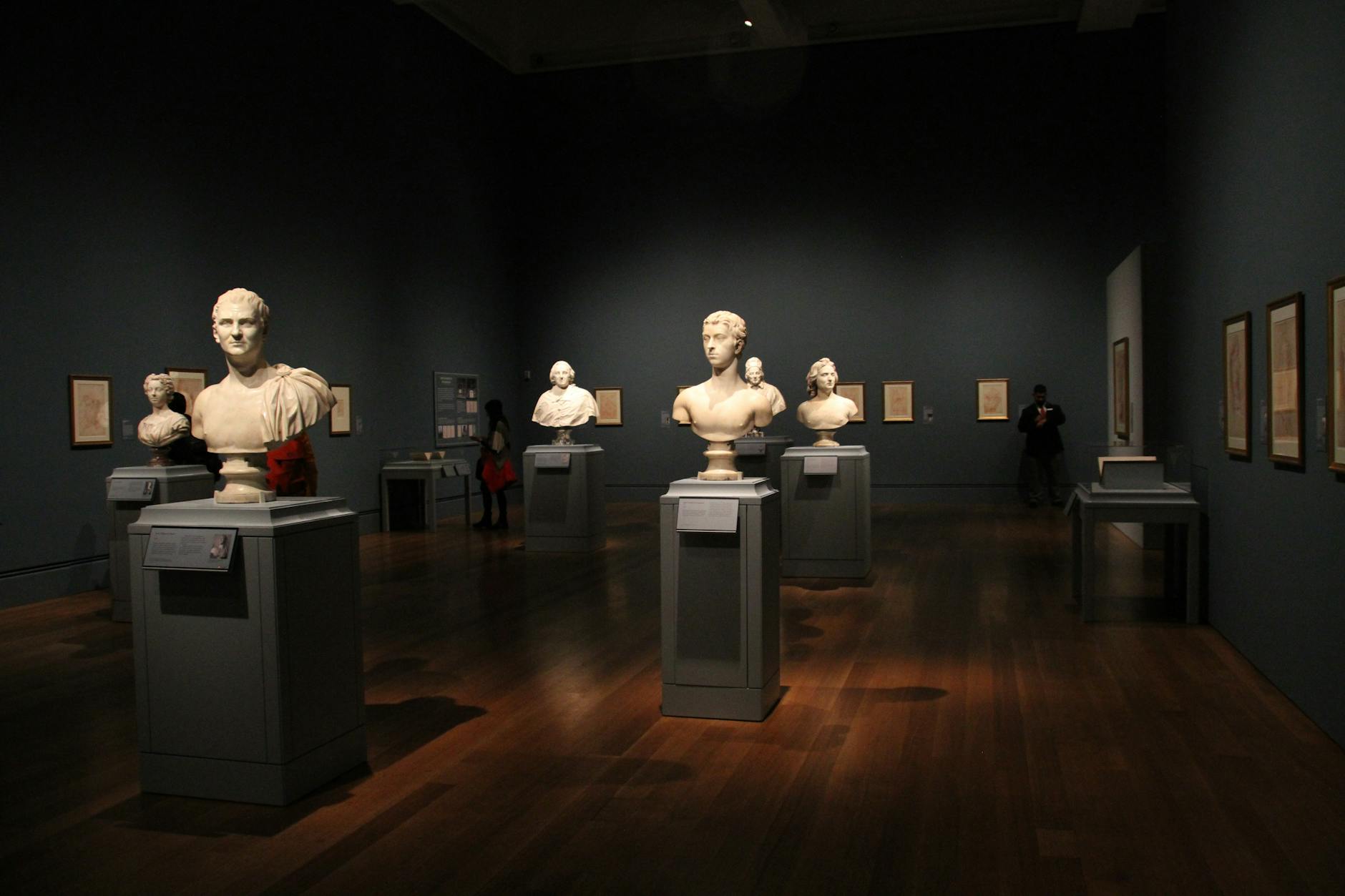
Art History Timeline From Ancient to Modern: A Visual Journey
art history timeline from ancient to modern

Art History Timeline From Ancient to Modern: A Visual Journey

Unravel the captivating narrative of human creativity, from prehistoric caves to contemporary galleries, in this essential guide.

Begin Your Art Journey

Key Takeaways

  • ✓ Art predates written language, with the earliest known cave paintings dating back over 40,000 years.
  • ✓ The Renaissance marked a profound shift, reintroducing classical ideals and humanism into European art.
  • ✓ The Industrial Revolution profoundly influenced art, leading to movements like Realism and Impressionism.
  • ✓ Modern art (late 19th to mid-20th century) saw radical experimentation and a break from traditional forms.

How It Works

1
Start with Ancient Foundations

Begin by understanding the earliest forms of human expression, from cave paintings to the monumental structures of Egypt and Mesopotamia. Grasp how early societies used art for ritual, storytelling, and power.

2
Navigate Classical and Medieval Eras

Delve into the ideals of beauty and proportion in Greek and Roman art, then witness the spiritual narratives and intricate craftsmanship of the Byzantine and Medieval periods. Observe the evolution of religious iconography and architectural styles.

3
Experience Renaissance to Enlightenment

Immerse yourself in the rebirth of classical learning and humanism during the Renaissance, followed by the dramatic flair of Baroque and the refined elegance of Rococo. Understand how scientific advancements and philosophical shifts impacted artistic representation.

4
Explore Modern and Contemporary Art

Trace the revolutionary movements from Impressionism to Cubism, Surrealism, and Abstract Expressionism, leading to today's diverse contemporary practices. Recognize the impact of technology, globalization, and social change on artistic creation.

The Dawn of Creativity: Prehistoric & Ancient Art
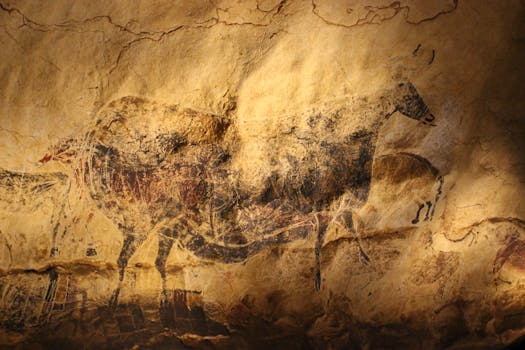
Explore the historic Lascaux cave painting, a UNESCO World Heritage site. Photo: toshihiko tanaka / Pexels
The story of art is as old as humanity itself, beginning long before written records or established civilizations. Our journey through the art history timeline from ancient to modern must commence with the earliest expressions of human creativity: prehistoric art. These initial forays into visual communication, often found deep within caves or carved into portable objects, offer a profound glimpse into the minds of our ancestors. The Upper Paleolithic era, dating back over 40,000 years, gave us masterpieces like the cave paintings of Lascaux and Altamira. These intricate depictions of animals—bison, horses, deer—are not merely decorative; they are thought to have held ritualistic significance, perhaps related to hunting magic or spiritual beliefs. The skill and observation required to create these works, often in challenging conditions, speak volumes about early human ingenuity. Beyond cave walls, small sculptures like the 'Venus of Willendorf' suggest an early focus on fertility and the human form, albeit in highly stylized ways. These artifacts are invaluable as they represent the very genesis of symbolic thought and artistic representation. As societies began to form, art evolved to serve new purposes. In ancient Mesopotamia, the cradle of civilization, art became a powerful tool for rulers and religion. Sumerian, Akkadian, Babylonian, and Assyrian art showcased monumental architecture, intricate cylinder seals, and powerful relief sculptures depicting gods, kings, and epic battles. The Standard of Ur, with its narrative panels, provides a vivid snapshot of early warfare and peacetime activities. Egyptian art, spanning thousands of years, is perhaps the most enduring symbol of ancient artistic prowess. Characterized by its strict adherence to conventions, hieratic scale, and emphasis on the afterlife, Egyptian art created an aesthetic of timelessness and monumental permanence. From the colossal pyramids and sphinxes to the exquisite tomb paintings and funerary masks, every piece served a purpose, often to ensure the deceased's eternal well-being or to glorify the pharaohs as divine rulers. The consistent style across millennia highlights a culture deeply rooted in tradition and a profound belief system. These early civilizations laid the groundwork for future artistic developments, establishing concepts of narrative, symbolism, and the use of art for political and spiritual power. Understanding these foundational periods is crucial for appreciating the subsequent shifts and transformations in artistic expression across the globe. They remind us that art is not a luxury, but a fundamental human need, a way to make sense of the world and our place within it.

Classical Ideals & Medieval Narratives: Greece, Rome, & Beyond
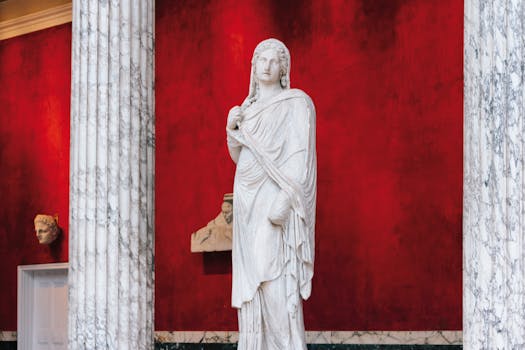
Marble statue in Ny Carlsberg Glyptotek, Copenhagen's renowned art museum. Photo: Erik Schereder / Pexels
Following the foundational periods, the art history timeline from ancient to modern progresses through the classical civilizations of Greece and Rome, and then into the rich tapestry of the Medieval era. Ancient Greek art, particularly from the Archaic, Classical, and Hellenistic periods, represents a pivotal moment in Western art. The Greeks pioneered a focus on the idealized human form, striving for perfection in anatomy and proportion. Their sculpture, initially rigid and frontal, evolved into dynamic, naturalistic representations that conveyed emotion and movement. Think of the serene beauty of the Parthenon sculptures or the dramatic tension of the Laocoön Group. Architecture, too, reached new heights with the development of the Doric, Ionic, and Corinthian orders, creating structures that embodied balance, harmony, and civic pride. Greek pottery, adorned with mythological scenes and daily life, offers invaluable insights into their culture and storytelling traditions. The Greek emphasis on reason, beauty, and human potential profoundly influenced subsequent generations of artists. Roman art, while heavily influenced by Greek precedents, developed its own distinct character, often characterized by practicality, grandeur, and a focus on realism. Roman sculptors excelled at portraiture, capturing individual likenesses with unprecedented accuracy. Their architecture was revolutionary, utilizing concrete, arches, and vaults to create monumental public works like the Colosseum, the Pantheon, and vast aqueducts. Roman art served the empire, celebrating its power, military victories, and emperors. Narrative reliefs, such as those on Trajan's Column, chronicled historical events with meticulous detail. The Romans' ability to adapt and innovate, integrating art into their daily lives and infrastructure, set them apart. The fall of the Roman Empire ushered in the Medieval period, a thousand-year span often mischaracterized as a 'dark age.' However, Medieval art is anything but. It is a period of intense spiritual devotion, artistic innovation, and regional diversity. Early Christian art emerged in the catacombs, developing iconography that would define religious art for centuries. Byzantine art, centered in Constantinople, was characterized by its dazzling mosaics, iconic paintings, and opulent religious architecture, all designed to evoke spiritual awe and imperial majesty. Romanesque art, prevalent across Europe from the 11th to 12th centuries, saw the rise of massive stone churches, often adorned with lively sculpted portals and frescoes, reflecting a renewed interest in pilgrimage and monumental storytelling. Finally, the Gothic era, beginning in the 12th century, brought soaring cathedrals with intricate stained-glass windows, delicate tracery, and naturalistic sculpture, all designed to elevate the worshipper towards the divine. These periods demonstrate art's evolving role, from classical ideals to spiritual narratives, constantly adapting to the cultural and religious currents of their time.

Rebirth & Revolution: Renaissance to the Enlightenment

The transition from the Medieval era to the Renaissance marked a profound shift in the art history timeline from ancient to modern, a 'rebirth' of classical ideals and a renewed focus on humanism. Beginning in 14th-century Italy, the Early Renaissance saw artists like Giotto and Masaccio break from Byzantine conventions, introducing greater naturalism and emotional depth into their work. The High Renaissance, epitomized by Leonardo da Vinci, Michelangelo, and Raphael, represents a pinnacle of artistic achievement. Leonardo's scientific curiosity infused his art with unparalleled realism and psychological insight (e.g., the Mona Lisa), while Michelangelo's monumental sculptures and Sistine Chapel frescoes showcased the human form in its most heroic and dramatic expressions. Raphael's harmonious compositions and serene Madonnas embodied classical beauty. This period also saw the development of linear perspective, oil painting techniques, and a greater emphasis on individual artistic genius. The Renaissance spread across Europe, influencing the Northern Renaissance masters like Jan van Eyck and Albrecht Dürer, who brought their own distinct meticulous detail and symbolic richness. Following the High Renaissance, the Mannerist period emerged, characterized by its artificiality, elongated forms, and complex compositions, often challenging the classical harmony established by its predecessors. Artists like Parmigianino and El Greco pushed the boundaries of convention, leading art into a more expressive and less naturalistic direction. The Baroque era, spanning the 17th century, was a period of dramatic flair, intense emotion, and grandeur, often commissioned by the Catholic Church as part of the Counter-Reformation. Artists like Caravaggio, with his dramatic use of chiaroscuro, and Gian Lorenzo Bernini, with his dynamic sculptures and architectural designs, created works that were theatrical, awe-inspiring, and designed to evoke strong emotional responses. In the Netherlands, artists like Rembrandt and Vermeer explored realism, light, and everyday life with profound psychological depth. The 18th century saw the rise of Rococo, a lighter, more ornamental style characterized by delicate pastels, playful themes, and intricate decorative elements, often associated with aristocratic salons and courtly life. Artists like Fragonard and Watteau captured moments of leisure and romance with exquisite charm. This period was followed by Neoclassicism, a reaction against the perceived frivolity of Rococo, which drew inspiration directly from the archaeological discoveries of ancient Greece and Rome. Artists like Jacques-Louis David championed themes of civic virtue, heroism, and moral clarity, reflecting the intellectual currents of the Enlightenment and the revolutionary spirit of the age. Neoclassical art provided a visual language for the ideals of reason, order, and democracy, directly influencing the aesthetics of the nascent United States. This journey from the humanistic focus of the Renaissance to the rational ideals of Neoclassicism demonstrates a continuous dialogue with the past while constantly pushing towards new forms of expression and meaning, laying the groundwork for the radical changes to come in modern art.

Revolutionary Shifts: Modern Art Movements & Beyond

The 19th and 20th centuries represent a period of unprecedented upheaval and innovation in the art history timeline from ancient to modern. The Industrial Revolution, political revolutions, and rapid scientific advancements profoundly reshaped society, and art responded by breaking away from traditional academic conventions. Romanticism emerged in the early 19th century as a reaction against the rationalism of Neoclassicism, emphasizing emotion, individualism, and the sublime in nature. Artists like Eugène Delacroix and J.M.W. Turner explored dramatic narratives and intense personal feeling. Realism followed, focusing on depicting ordinary life and social issues without idealization, with Gustave Courbet famously stating, 'Show me an angel, and I'll paint one.' This commitment to depicting the world as it truly was paved the way for even more radical departures. Impressionism, arising in the 1860s, is often considered the beginning of modern art. Artists like Claude Monet, Pierre-Auguste Renoir, and Edgar Degas focused on capturing fleeting moments of light and color, the subjective perception of a scene rather than its precise detail. Their loose brushstrokes and vibrant palettes were revolutionary. Post-Impressionists like Vincent van Gogh, Paul Cézanne, and Paul Gauguin built upon Impressionism but injected greater emotional expression, structural rigor, or symbolic meaning into their work, paving the way for further abstraction. The early 20th century exploded with avant-garde movements. Fauvism, led by Henri Matisse, used bold, non-naturalistic colors. Cubism, developed by Pablo Picasso and Georges Braque, shattered traditional perspective, representing subjects from multiple viewpoints simultaneously. Surrealism, influenced by Freudian psychology, explored the subconscious mind through dreamlike imagery, with artists like Salvador Dalí and René Magritte. Abstract Expressionism, emerging after World War II, saw American artists like Jackson Pollock and Mark Rothko emphasize spontaneous, gestural, and non-representational forms, reflecting post-war anxieties and individual expression. Pop Art, in the 1960s, challenged the elitism of art by incorporating consumer culture and mass media imagery, exemplified by Andy Warhol. The late 20th and 21st centuries have seen a proliferation of styles and approaches, often termed Contemporary Art. This period is characterized by its diversity, conceptual focus, and engagement with social, political, and technological issues. Performance art, installation art, video art, and digital art have joined traditional mediums, blurring the boundaries of what constitutes 'art.' There's no single dominant style, but rather a constant questioning, experimentation, and engagement with global perspectives. From ancient cave paintings to today's digital installations, the art history timeline reveals a continuous human endeavor to understand, interpret, and shape our world through creative expression.

Comparison

Artistic PeriodKey CharacteristicsDominant MediumsNotable Artists
Ancient (Prehistoric-500 CE)Ritualistic, symbolic, monumental, afterlife focusCave paintings, sculpture, architecture, potteryUnknown (Lascaux), Imhotep (Egypt)
Classical (800 BCE-400 CE)Idealized human form, balance, civic virtue, realismSculpture, architecture, frescoes, mosaicsPhidias (Greece), Praxiteles (Greece)
Medieval (500-1400 CE)Spiritual, narrative, religious iconography, symbolicMosaics, stained glass, illuminated manuscripts, sculptureGiotto (Early Renaissance bridge)
Renaissance (1400-1600 CE)Humanism, perspective, naturalism, rebirth of classicalOil painting, fresco, sculpture, architectureLeonardo da Vinci, Michelangelo, Raphael
Baroque (1600-1750 CE)Dramatic, emotional, grandeur, movement, chiaroscuroOil painting, sculpture, architectureCaravaggio, Bernini, Rembrandt
Modern (1860-1970 CE)Experimentation, abstraction, subjective perception, social commentaryOil painting, sculpture, photography, collageMonet, Picasso, Van Gogh, Pollock, Warhol
Contemporary (1970-Present)Diverse, conceptual, global, interdisciplinary, digitalMixed media, installation, video, performance, digitalAi Weiwei, Yayoi Kusama, Banksy

What Readers Say

"This art history timeline from ancient to modern is incredibly thorough and engaging. It made complex periods easy to understand, and I finally grasp the connections between different movements. A must-read for any art enthusiast!"

Sarah J. · Boston, MA

"As someone who always felt intimidated by art history, this article was a revelation. The chronological flow and clear explanations helped me build a solid foundation. I especially appreciated the insights into how social changes influenced art."

Michael R. · San Francisco, CA

"I used this guide to prepare for a gallery tour, and it enhanced my experience tenfold. I could identify styles and understand the historical context of the works, leading to much richer conversations with the docents. Truly premium content."

Emily C. · New York, NY

"While extremely comprehensive, I found some sections to be quite dense. However, the depth of information provided is exceptional, making it a valuable resource for students and serious art lovers. A few more visual examples would have been great, but the writing is stellar."

David L. · Chicago, IL

"I'm a self-taught artist, and understanding the art history timeline from ancient to modern has been crucial for my own development. This article provided the historical framework I needed to appreciate the lineage of artistic innovation. Highly recommend for anyone looking to deepen their artistic knowledge."

Jessica M. · Austin, TX

Frequently Asked Questions

What is the earliest known art on the art history timeline from ancient to modern?

The earliest known art dates back to the Upper Paleolithic period, over 40,000 years ago. This includes cave paintings like those found in Chauvet, Lascaux, and Altamira, depicting animals and abstract symbols. These works provide crucial insights into the cognitive and symbolic abilities of early humans.

Is it possible to understand modern art without knowing ancient art?

While modern art often intentionally breaks from tradition, understanding ancient art provides essential context. Many modern movements were direct reactions to or reinterpretations of classical ideals. Knowing the 'rules' that were broken helps to appreciate the revolutionary nature of modern and contemporary art, making your understanding much richer.

How can I best study the art history timeline from ancient to modern?

The best way to study is chronologically, as presented here, to understand the evolution of ideas and techniques. Supplement reading with visits to museums and galleries, watch documentaries, and actively analyze artworks yourself. Focus on identifying key characteristics of each period and how they reflect their respective cultures.

What is the most significant turning point in the art history timeline?

Many scholars consider the Renaissance a pivotal turning point, as it marked a 'rebirth' of classical learning and a profound shift towards humanism, perspective, and individual artistic genius, laying foundations for much of Western art that followed. However, the advent of photography in the 19th century and the subsequent rise of abstraction in the 20th century also represent monumental shifts.

How does art from different regions fit into this timeline?

This timeline primarily focuses on Western art history, which is a common approach due to its direct influence on many global movements. However, it's crucial to remember that vibrant and rich art traditions existed simultaneously in other regions like China, India, Africa, and the Americas. A truly comprehensive study would integrate these diverse global perspectives to form a holistic view.

Who should use this art history timeline from ancient to modern?

This timeline is ideal for students, art enthusiasts, budding artists, and anyone curious about the trajectory of human creativity. It's designed for those seeking a comprehensive yet accessible overview, whether for personal enrichment, academic pursuits, or to simply enhance their appreciation of art in museums and galleries.

Is art history a continuous progression, or are there breaks?

Art history is more akin to a winding river with currents, eddies, and occasional rapids rather than a straight line. While there's a general flow, there are also periods of radical breaks, revivals of past styles, and simultaneous developments in different regions. It's a dynamic interplay of continuity and disruption, reflecting human innovation and societal change.

What are the future trends in art as seen through this timeline?

Building on the contemporary period, future trends are likely to continue exploring the impact of technology (AI art, virtual reality), globalization (intercultural dialogues), and pressing social and environmental issues. Expect further blurring of traditional mediums, increased audience participation, and art that actively engages with the digital realm and global challenges.

Embark on your own journey through the unparalleled beauty and complexity of human expression. This art history timeline from ancient to modern is your essential guide to understanding the masterpieces that have shaped our world. Dive in and discover the stories behind the art.

Topics: art history timeline from ancient to modernancient artrenaissance artmodern art movementsartistic periods
Leo List

IE Escorts NO Escorts US Escorts NZ Escorts AU Escorts
Brampton weed
Adultwork EstrelaBet Vai de Bet R7 Bet Betão Galera Bet Rainbet Bet9ja Shop SportyBet BetKing Sisal Loto Foot Hollywoodbets YesPlay Odibets RushBet Jugabet BetWarrior BetCity MSport betPawa Fortebet